
Joint Crediting Mechanism, JCM of Japan Consulting & Project Development
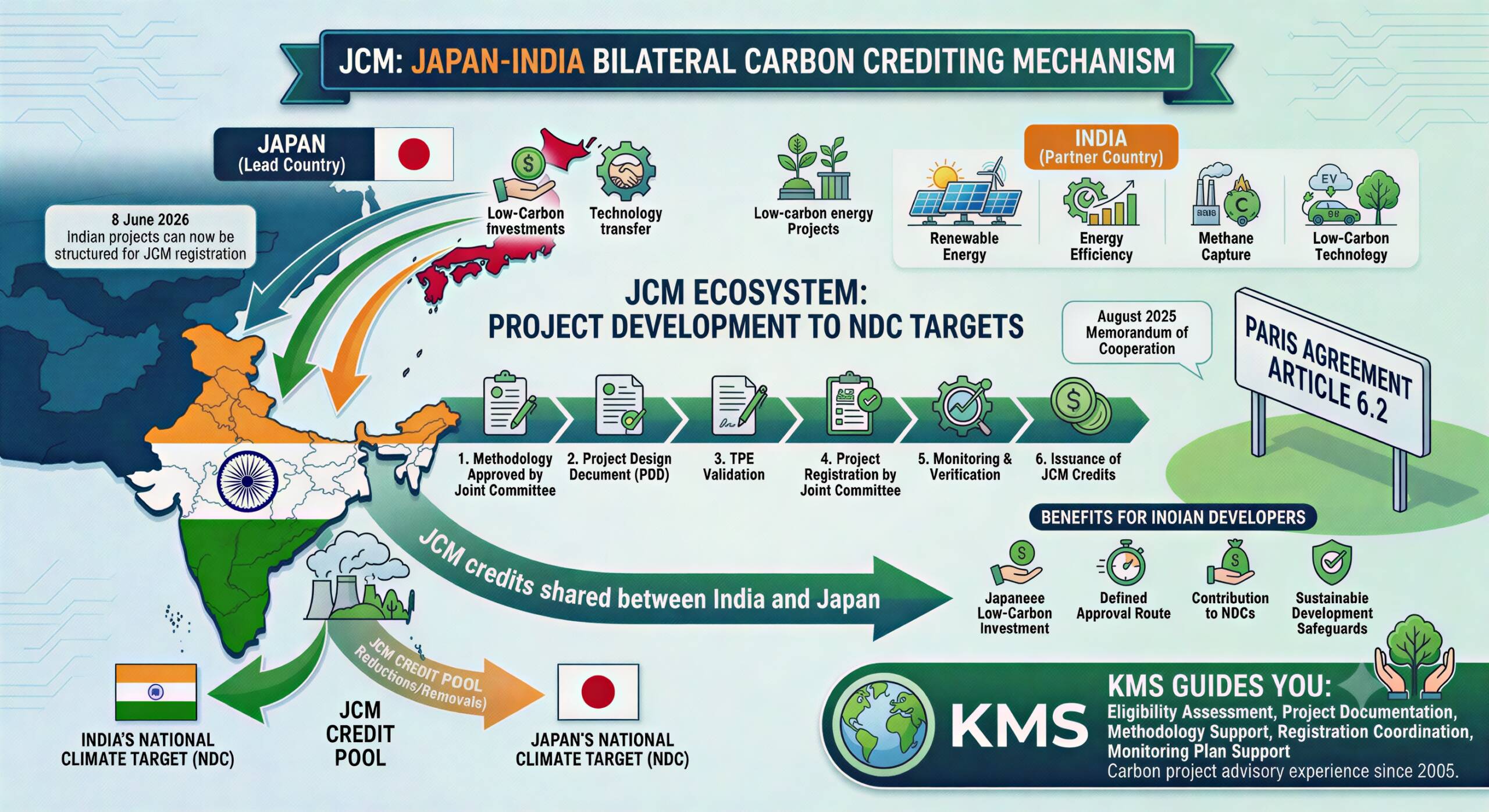
The Joint Crediting Mechanism (JCM) is Japan’s bilateral carbon crediting mechanism under Article 6.2 of the Paris Agreement. A project in a partner country generates verified emission reductions or removals. The credits are shared between Japan and the host country, with each side counting its share toward its national climate target.
For project developers in India this stopped being theory in 2026. India and Japan adopted the Rules of Implementation for the JCM on 8 June 2026, turning the 2025 Memorandum of Cooperation into a working framework. There is now a defined route to register an Indian project, draw Japanese low carbon investment and issue Article 6.2 credits. KMS helps you use it.
JCM at a glance
- Full form: Joint Crediting Mechanism
- Framework: Article 6.2 of the Paris Agreement
- Lead country: Japan, working bilaterally with each partner
- India status: Rules of Implementation adopted 8 June 2026, after the August 2025 Memorandum of Cooperation
- Where it applies: JCM partner countries, around 32 as of April 2026, India included
- What it produces: verified emission reductions or removals, issued as JCM credits and tracked in national registries
- What the credits do: count toward both countries’ Nationally Determined Contributions
What the JCM now means for Indian developers
The Rules of Implementation are the part that matters commercially. They set up the governance that lets real projects move: a Joint Committee of both governments to approve projects, third party validation and verification, sustainable development safeguards and national registries that track issuance and transfer so credits are not double counted.
In plain terms, an Indian renewable energy plant, an industrial efficiency retrofit or a methane capture project can now be structured to earn JCM credits and attract Japanese investment under a route both governments recognise. That was a stated ambition when the two countries signed the MoC. As of June 2026 it has rules you can build a project against.
How a JCM project works
Whatever the country, a JCM project runs along the same backbone:
- Methodology. The project applies an approved JCM methodology, or a new one is written and put to the Joint Committee.
- Project design. A project design document sets out the technology, the baseline and how reductions get measured.
- Validation. A Third Party Entity checks the design against the rules.
- Registration. The Joint Committee registers the project.
- Monitoring and verification. Operating data is collected, then verified against the methodology.
- Issuance. Credits are issued and shared between the host country and Japan.
Funding is not automatic, but it is often available. Depending on the country, the technology and how the project is structured, a JCM project may qualify for Japanese government linked support such as model project financing or Asian Development Bank channels. That possibility is part of why the route is worth checking early.
Who should consider JCM project development?
The JCM fits eligible mitigation activity in a partner country. In practice that means renewable energy developers, industrial energy efficiency projects, waste and methane management, transport decarbonisation, afforestation and similar projects that cut or remove emissions and can prove it with solid data. If your project sits in a JCM partner country and has a credible baseline, it is worth testing against the mechanism.
JCM, the CDM and voluntary standards
The JCM is project based crediting, like the systems before it, but built for the Paris era. Approvals tend to move faster than the old Clean Development Mechanism, because each partnership runs its own Joint Committee instead of one central board. The host country shares the credits rather than only hosting the project. And the credits count toward both countries’ NDCs, which the CDM was never built to do.
It also sits apart from the voluntary carbon standards like Verra and the Gold Standard. A reduction sold as a JCM credit under Article 6.2 carries a corresponding adjustment between governments, so the same tonne cannot also be claimed in the voluntary market. Choosing the right home for a project before you spend on paperwork is the call that decides its economics.
What KMS does on a JCM project
You own the project. We run the work that turns it into issued credits and keep it from stalling.
That means testing whether the project actually fits the JCM, finding or writing the right methodology, building the project design document, getting you through Third Party Entity validation and verification, handling registration with the Joint Committee and setting up monitoring that holds up. Projects usually stall on the same few things: a weak baseline, thin monitoring data or a documentation gap an auditor catches late. We work to close those before they cost you a cycle.
We have developed carbon and GHG projects since 2007, under the CDM, Verra’s VCS, the Gold Standard and the Global Carbon Council. The JCM leans on the same fundamentals: a defensible baseline, clean data and a file an auditor cannot pick apart.
JCM FAQ
Can Indian projects now use the Joint Crediting Mechanism?
Yes. India and Japan adopted the JCM Rules of Implementation on 8 June 2026, which operationalises the framework they agreed in the 2025 Memorandum of Cooperation. Indian projects in eligible sectors can now be structured to register under the mechanism and issue Article 6.2 credits.
Is the JCM part of Article 6 of the Paris Agreement?
Yes. The JCM works as a cooperative approach under Article 6.2, which lets two countries trade mitigation outcomes and count them toward their national targets. Japan runs it through bilateral agreements rather than a central UN body.
How are JCM credits shared between countries?
Each project’s credits are split between the host country and Japan, with the ratio set by the Joint Committee for that partnership. Both governments apply their share to their own Paris Agreement target, with a corresponding adjustment so the same reduction is not counted twice.
How is the JCM different from the CDM?
The CDM ran through one central board and treated developing countries as hosts. The JCM gives each partner country its own Joint Committee and a share of the credits, and it counts toward both countries’ NDCs, which the CDM did not.
How many countries are in the JCM?
Japan listed around 32 JCM partner countries as of April 2026 on the official JCM platform, with India’s framework operationalised in June 2026. A project has to sit in a partner country to register under the mechanism.
Talk to us about your project
Tell us the technology and the country it sits in. We will tell you whether the JCM is the right route, what registration takes and where the risks are. For Indian projects, that conversation is more useful now than it has ever been.
Add Comment