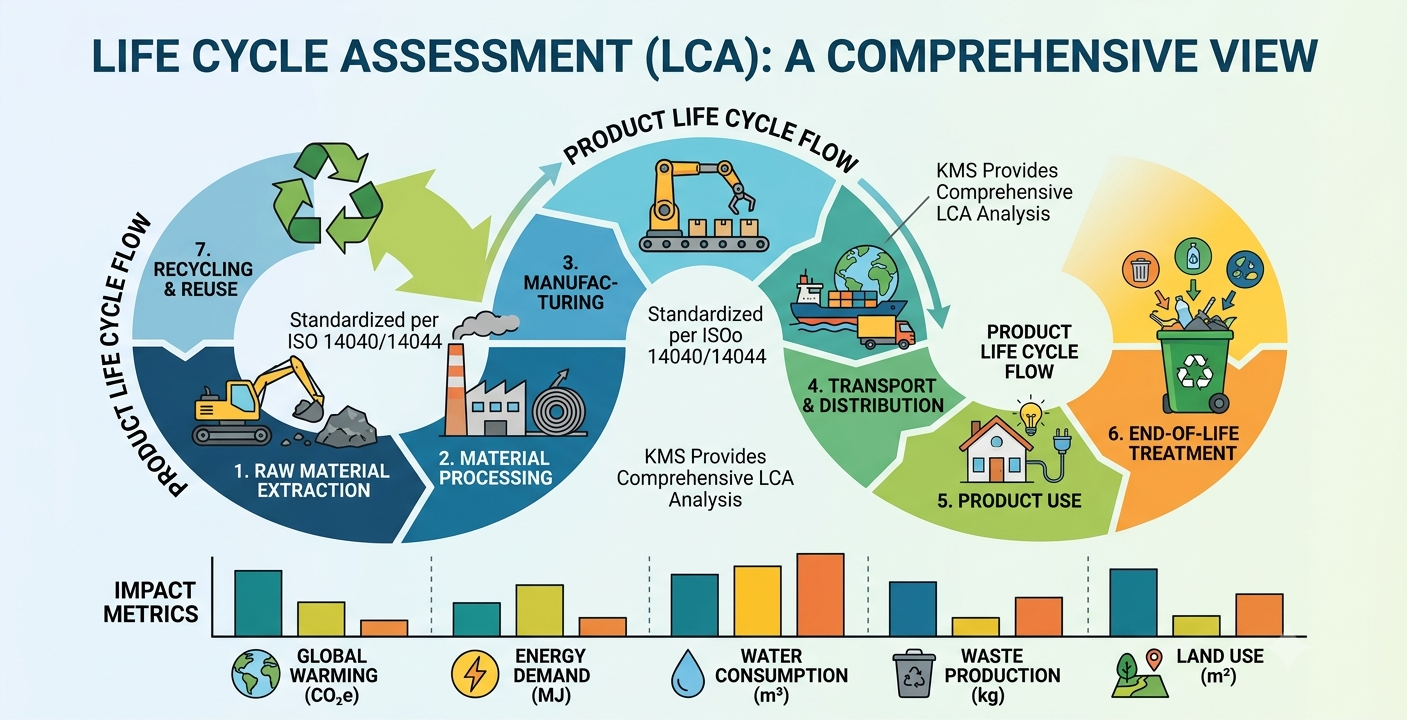
Life Cycle Assessment (LCA) is a systematic methodology for evaluating the environmental impacts of a product, process, or service throughout its entire life cycle, from raw material extraction through production, use and disposal or recycling. It provides a comprehensive view of the environmental burdens associated with a product or activity, helping decision makers identify opportunities for reducing environmental impacts and improving sustainability. KMS is well equipped to offer these comprehensive LCA services, ensuring thorough analysis and actionable insights.
What a life cycle assessment measures
An LCA follows a product from cradle to grave: raw material extraction, manufacturing, transport, use and end of life. At each stage it counts the environmental load, carbon emissions, energy, water, waste, land use, so the full footprint of a product is visible, not just the part that happens inside the factory. The discipline is standardised. ISO 14040 sets out the principles and framework for an LCA and ISO 14044 the requirements and guidelines, which is what stops a study being a marketing exercise.
Where an LCA leads
A finished LCA is rarely the end goal. It is the input to a decision. It shows which stage of a product’s life does the most damage, which is where redesign pays off. It underpins a product carbon footprint under ISO 14067 and an Environmental Product Declaration under ISO 14025, the documents customers and regulators increasingly ask for. And it gives a company the hard number behind any product level climate claim. Where formal EPD publication or third party verification is required, KMS supports the preparation and documentation and coordinates with the relevant programme operator or verifier, the assessment itself sits with that accredited party.
How KMS approaches LCA
Kanaka Management Services (KMS Group) runs LCAs end to end: defining the scope and boundaries, building the life cycle inventory, modelling the impacts and turning the result into something a team can act on. The carbon piece connects to the rest of what KMS does. Once a product’s footprint is measured, cutting it where possible and offsetting the remainder with credible carbon credits is the next step and KMS works on both. It is the product level companion to our sustainability and ESG reporting work, draws on the same data as our energy audits, and the credits themselves come from projects developed under standards like Verra and REDD+. The wider picture sits in our carbon credit knowledge hub.
Frequently asked questions
What is a life cycle assessment (LCA)?
A life cycle assessment is a method for measuring the environmental impact of a product, process or service across its whole life from raw material extraction through manufacturing, use and disposal. It gives a complete picture of a product’s environmental burden, not just one stage, and follows the ISO 14040 and 14044 standards.
What are the stages of an LCA?
A full LCA covers raw material extraction, production, transport, use and end of life, whether that is disposal or recycling. This is often called cradle to grave. The point is to capture impacts at every stage, since the biggest environmental load is often somewhere a company would not expect.
What is the difference between an LCA and a carbon footprint?
A carbon footprint measures one thing, greenhouse gas emissions. An LCA is broader, covering carbon plus energy, water, waste and other impacts across the life cycle. A product carbon footprint, measured under ISO 14067, is effectively the carbon slice of an LCA.
What is an LCA used for?
Companies use LCAs to find where a product does the most environmental damage and where to redesign it, to produce Environmental Product Declarations that customers ask for and to back up product sustainability claims with real data. Increasingly it also feeds supply chain and regulatory reporting.
Does KMS provide ISO aligned LCA support?
Yes. KMS supports LCA studies aligned with the ISO 14040 and 14044 principles and requirements, including goal and scope definition, inventory development, impact assessment, interpretation and reporting. Where formal third party review or verification is required, KMS supports the preparation and coordinates with the relevant reviewer or verifier.
How does an LCA connect to carbon credits?
An LCA quantifies a product’s carbon footprint as part of its wider environmental impact. Once that number is known, a company can reduce emissions where it can and offset the rest with carbon credits. KMS works on both the assessment and the offsetting, so the footprint leads straight into action.
Talk to a KMS LCA consultant
Need a life cycle assessment, a product carbon footprint or an EPD? Tell us the product or process and where you want to get to and we will scope it.
Add Comment